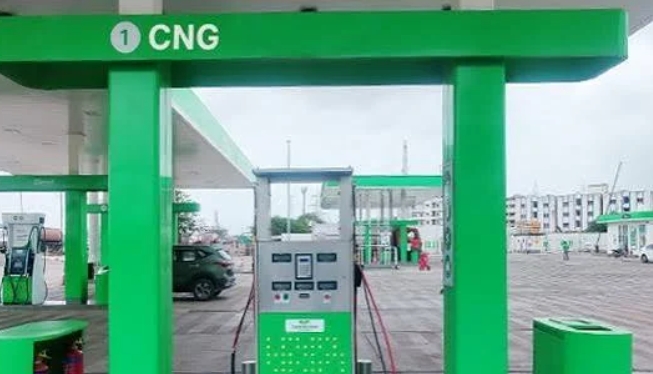
Abuja- As the Federal Government moves to deliver measurable reductions in transportation costs from October 1, states are adopting different approaches to the Compressed Natural Gas initiative, with some already operating subsidised transport services while commercial operators in several others complain about inadequate refuelling infrastructure, high conversion costs and long queues at existing stations.
The uneven rollout has raised questions about the ability of transport operators and state governments to deliver cheaper fares across the country within the timeline set by President Bola Tinubu.
The President, after meeting the 36 state governors on August 27, announced an implementation committee for the National Affordable CNG Transit Programme under the Nigeria Governors’ Forum, chaired by Governor AbdulRahman AbdulRazaq.
In an update on Saturday, Tinubu urged states to work with transport unions and commercial operators, support vehicle conversion and fleet deployment, and ensure that savings from cheaper energy were passed on to commuters through lower fares. The Presidency said more than 120,000 vehicles had been converted, with over 400 certified conversion centres and more than 90 CNG refuelling stations across the country.
But while the Federal Government says the infrastructure is expanding, transport operators in some states say the available facilities remain inadequate to support widespread conversion.
The challenge is particularly evident in areas where motorists already using CNG spend several hours waiting to refuel.
CNG queues
In Lagos, CNG queues have continued to be reported at some filling stations, including the NIPCO facility at Ibafo along the Lagos-Ibadan Expressway. At about 9:30 pm during one such visit, buses, cars and trucks were seen waiting to buy CNG, with the queue extending towards the highway.
A commercial driver, Saheed, said the scarcity of stations was forcing operators to spend hours waiting for the product.
“We have been here since 7:30 pm. My bus is just getting close to the pump. The reason for this queue is because we have a few CNG stations along this axis. Some have left to go and buy petrol, but N1,400 is too much for a commercial driver. That’s why you see my buses here,” he said.
A commuter who expressed frustration with the queues said the delays were discouraging some passengers from using CNG-powered buses. “This is why I don’t like boarding CNG buses. Aside from asking to disembark from the bus, they will also delay your journey by staying in the queue,” the commuter said.
Similar queues have been reported around Mowe and Ibafo, as well as at NNPC Ilasamaja and NIPCO Mobil on Ajegunle Road. For some commercial operators, the problem is not only the availability of CNG but also the cost of converting their vehicles.
A commercial driver, Musa Kazeem, said he had considered converting his vehicle but was discouraged by the cost and the prospect of spending hours at refuelling stations.
“I planned to convert my vehicle last month, but they told me to look for N800,000 or N1m, depending on the size of the cylinders I want. Where will I get that? Another issue is, after doing the conversion, I will have to stay in a long queue for hours to buy the product. It now looks as if the CNG stations inherited the petrol queues we used to have before the Dangote refinery became operational,” he said.
Another concern among some motorists and passengers is safety. A middle-aged man, Oladeinde Lekan, said he remained worried about the possibility of CNG-related accidents despite government assurances about safety.
The shortage of stations has also attracted concern from transport industry leaders.
NARTO SPEAKS
The National Association of Road Transport Owners National President, Yusuf Othman, said the queues were costing operators valuable time.
“The queues in CNG stations are really costing us time, because time is money. And this is because of the non-availability of refilling stations. The stations are not many; therefore, because of those long queues, we lose a lot of time and money,” he said.
Othman, however, said more stations were being developed and that increased infrastructure would gradually reduce the queues.
“There are a lot of CNG stations coming up. The government is intervening through the Midstream and Downstream Gas Infrastructure Fund. That will go a long way in having many stations, and with those many stations, of course, all those queues will reduce. You know, a lot of people are just keying into CNG. They are not used to it, but it’s gradual,” he said.
He added that despite the difficulties associated with the rollout, CNG remained cheaper than petrol.
“As it is now, CNG is the way to go. It’s clean energy, and it’s cheaper. The only problem is the queue, and when we have more stations, transporters will have no choice. Usually, people are susceptible to change. They don’t accept change easily. But then, this is a change that is coming with gains; because we are going to save a lot of money in the purchase of CNG as against petrol or diesel,” Othman said.
Source: Punch Newspaper