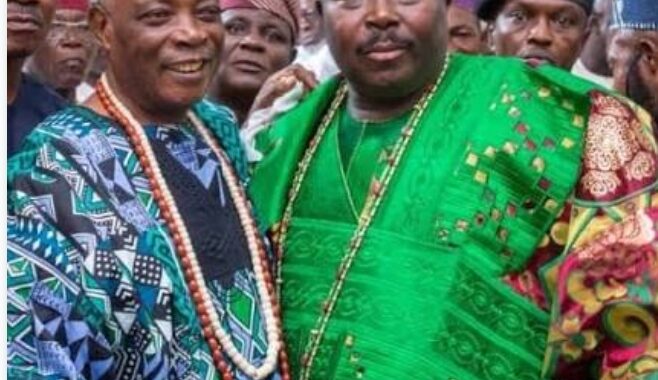
Ibadan – These piece should simply be tittled “Que sera, sera”, a phrase, “what will be, will be” in English, popularized by the Doris Day song, the phrase embodies a philosophy of embracing uncertainty, surrendering to fate, and releasing anxiety over uncontrollable outcomes.
That is the Ladoja story, but I want to tap into the grace of the outcome so I choose instead The phrase “The King and I” the 1956 classic Yul Brynner as King Mongkut, Deborah Kerr as Anna, in faraway Bangkok, a once favorite family movie we watched growing up. It resonated. I know this man in person, through proxy and through my profession as a media practitioner. This story is not in Bangkok, but in Ibadan, a story of two decades and the drama in-between.
I lived just four houses down from Senator Rashidi Adewolu Ladoja’s home on Ondo Street, Bodija. His wife’s family was our landlord. Political figures, power brokers, campaigners, they passed our gate like tides. My compound had political faithfuls as meeting points. I recollect one sad event of a bus full on party faithful who met their unfortunate fate on Iseyin road, they departed from my compound and many of them were known to me. Our street was used to the drama, but nothing as violent as what would come.
The Day Chaos Came
Precisely Twenty years ago, a calm morning turned into a nightmare. Heavily armed political thugs stormed the neighborhood. Gunshots cracked. They marched toward Number 28 Ondo Street. Repelled, yes, but the damage was done: my mother scarred by fear, my niece out on an errand and vulnerable, the aftermath was our gate riddled with bullet holes. That day altered the rhythm of our lives, injected a new tone of danger even into our conversations.
The Impeachment: Power, Betrayal, and the Courts
Ladoja had been elected Governor of Oyo State in 2003 on a PDP ticket. He defeated the incumbent, Lam Adesina, and had the support of powerful Ibadan stakeholders, most notably Lamidi Adedibu.
But by 2004, cracks had begun. Adedibu, the “strongman” of Ibadan politics, believed he had the right to control what are called security votes. These are discretionary funds often justified as being used for state security or related emergency expenses. Ladoja refused to hand those funds over. That set up a clash between the governor and those vested with informal political power in the state.
In January 2006, lawmakers loyal to Adedibu carried out Ladoja’s impeachment. His deputy, Adebayo Alao-Akala, was sworn in as governor.
Ladoja fought back in court. In November 2006, the Appeal Court in Ibadan declared the impeachment null and void. In December, the Supreme Court upheld the decision, effectively reinstating Ladoja.
Ladoja has since claimed that more than Adedibu was involved. He alleged that President Olusegun Obasanjo pressed for his resignation, especially because Ladoja had publicly said Obasanjo was not fit for a third term in office. Allegedly.
Ibadan Royalty & the Role of the Olubadan
To understand what Ladoja’s recent enthronement as Olubadan means, you need to know how Ibadan royalty works.
The Olubadan means “Lord of Ibadan”; he is the paramount traditional ruler of Ibadan land. The role is more than ceremonial, he is the custodian of traditions and an arbiter in community issues.
Succession is merit-based through a well-defined ladder of chieftaincy titles belonging to two lines: the Otun line and the Balogun line. Chiefs move up through stages (Jagun Balogun, Otun Balogun, etc.) until they are eligible to become Olubadan.
The Olubadan presides over the Olubadan-in-Council, which includes senior chiefs from both lines. These chiefs often lead traditional councils in the 11 local government areas across Ibadan land.
Oba Akinloye Olalere Owolabi Olakulehin became the 43rd Olubadan of Ibadanland in July 2024. His climb through the chieftaincy ladder was long and steady, spanning decades of service.
So when Ladoja became Olubadan designate recently, he entered a lineage steeped in ritual, symbolism, and influence, not just symbolic, but real, in how people look up to the custodian of their traditions.
Ladoja’s Political Influence Beyond the Chiefdom
Ladoja is more than a traditional ruler now; he has decades of political trail behind him:
He has been a businessman, senator, and governor. His influence runs across sectors: private enterprise, politics, culture.
Even after the impeachment, his comeback strengthened his reputation as someone who resists undue pressure, someone who values his office not just as a title but as a responsibility to his people.
In Ibadan, people see him as a bridge between tradition and modern governance. As Olubadan, he’s in a position where he can mobilize moral authority. He can advocate for development, mediate conflicts, and play a unifying role, especially in a city with diverse political leanings.
At 81 after lifes twist and turns, people call him an “intellectual, ethical force” not just for his past, but for what he can continue to do.
What It All Means: Que sera sera
So when I walk the street now, hearing crowds celebrate his enthronement, my mind drifts back to that morning 20 years ago. The same Ondo Street that echoed terror now echoes with jubilation. What once felt like downfall is now part of an arc toward majesty.
This is Ibadan reclaiming its power in tradition, in culture, in memory. This is Ladoja’s turn, not just in politics or law, but in lineage. He rises as Olubadan, a king in the fullest sense of the word.
Long live the King!
Long live Ibadan!!
Tony aka Don Tee