By Adebisi
Ibadan – In every election cycle, political advertising tends to become louder than the issues themselves.
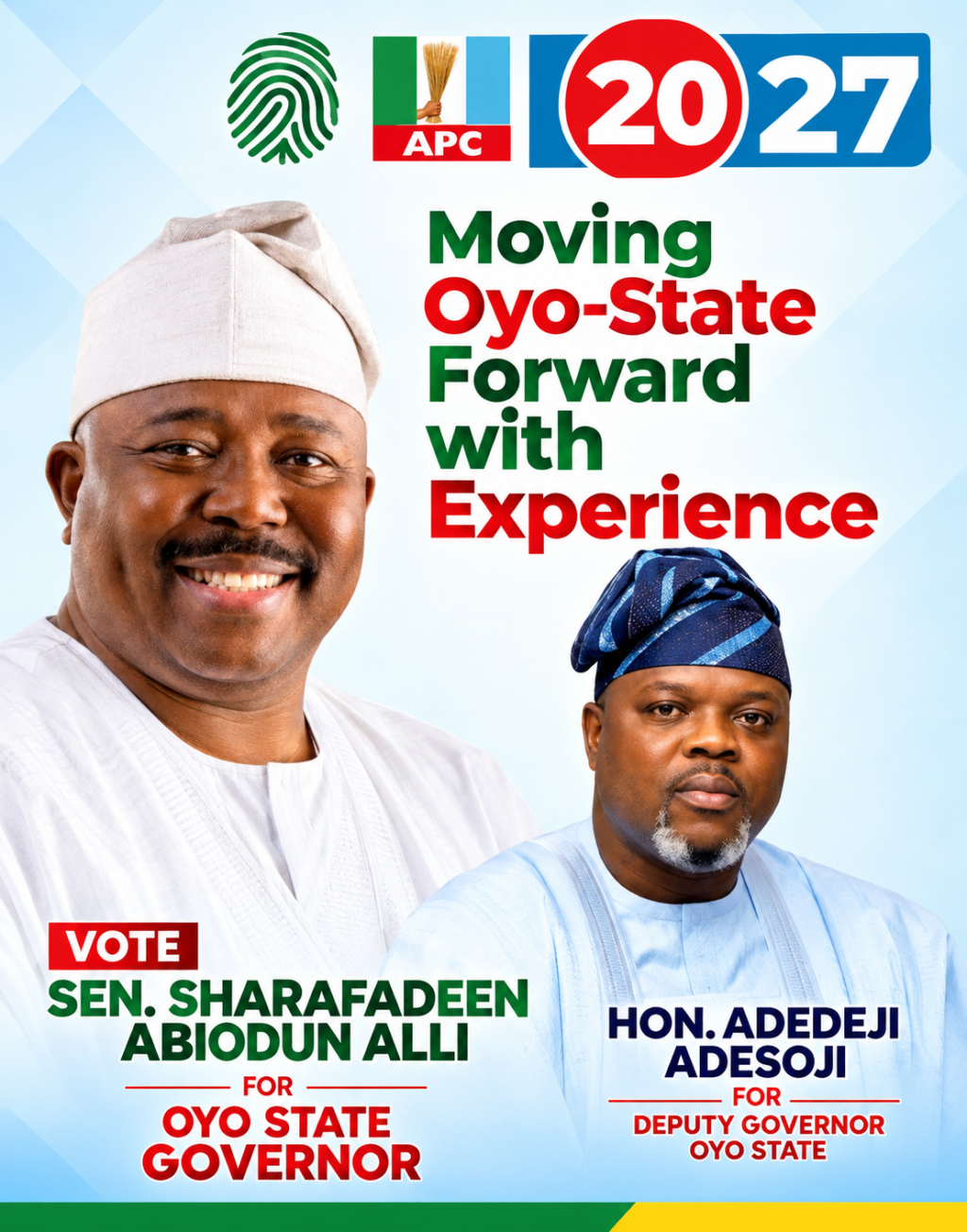
Billboards go up, slogans multiply and candidates present themselves as the answer to the problems of the moment.
But for a politician seeking to move from the National Assembly to the Government House, there is a more useful question than what appears on the billboard:

What does the record say?
For Senator Sharafadeen Abiodun Alli, the 2027 Oyo governorship conversation provides an opportunity to examine that question against his experience in public administration, legislative work and constituency interventions.
Alli is now the All Progressives Congress (APC) candidate for governor of Oyo State, having been formally unveiled by the party in September 2026.
He currently represents Oyo South Senatorial District in the National Assembly.
From local government to the Senate
One of the defining features of Alli’s political résumé is the range of positions he has occupied.
He served as the first democratically elected chairman of Ibadan North Local Government in 1991, later became Secretary to the Oyo State Government and subsequently served as Chief of Staff to Governor Rashidi Ladoja.These positions placed him at different levels of government administration before his emergence as a senator.
That history is relevant because the office of governor requires more than political visibility. It involves managing institutions, coordinating ministries and agencies, working with local governments, handling budgets and translating policy into programmes.
Whether Alli’s previous experience ultimately translates into effective state leadership is a question voters will judge, but his supporters can point to a career that has included both political administration and legislative responsibilities.
What has the senator done in the Senate?
The legislative record provides another area for examination.
Among the bills associated with Alli are the Federal Medical Centre, Igbo-Ora Bill, an amendment to the Pension Reform Act, the National Centre for Citizenship and Leadership Training Act amendment, the Chartered Institute of Auctioneers Bill and an amendment to the Agricultural Research Council Act. His Federal Medical Centre, Igbo-Ora Bill is listed as having passed into law.
His parliamentary activities have also included motions and interventions touching on issues such as workers’ welfare, road infrastructure, erosion, salary harmonisation and women’s representation.
The significance of these interventions goes beyond counting bills. A senator’s effectiveness is also reflected in constituency advocacy, committee work, oversight and the ability to connect federal institutions with local needs.
From legislation to constituency intervention
Alli’s published record also lists a number of constituency interventions.
These include more than 5,000 solar street lights, 41 water-access and borehole projects, healthcare interventions, agricultural support, vocational and e-commerce training, and employment facilitation for more than 100 constituents.
There are also social interventions, including support for widows and market traders and the Flow with Dignity programme, which the senator’s campaign says has reached 10,000 schoolgirls.
The broader question is whether such constituency-level interventions demonstrate an approach that can be scaled from a senatorial district to an entire state.
That is ultimately where the gubernatorial test becomes different.
The bigger test: can the Senate experience become state governance?
A governor does not simply replicate what a senator does.
The governor controls a much larger administrative machinery and has direct responsibility for education, healthcare, roads, security coordination, agriculture, local government relations, civil service administration and the state’s economic direction. Alli has consequently presented his proposed governorship around education, healthcare, security, infrastructure, agriculture, youth and women’s empowerment, digital transformation and civil-service reform.
His stated emphasis on entrepreneurship and investment is particularly notable.
In a May 2026 interview, he said his approach to youth development would combine investment attraction and formal employment with vocational training, technology hubs and access to credit for entrepreneurs.
These are, however, still policy commitments rather than completed gubernatorial outcomes. The real test would be how they are financed, prioritised, implemented and measured if he assumes office.
Beyond the billboards
Perhaps that is the real meaning of going beyond the rhetoric.
A billboard can tell the electorate what a candidate wants to become. A public record provides evidence of what the candidate has previously done.
In Alli’s case, the evidence includes experience at the local-government and state-government levels, legislative activity at the federal level and a published record of constituency projects and interventions.
It also leaves legitimate questions for voters to ask.
Can the administrative experience of the past translate into a modern and efficient Oyo State government? Can constituency interventions be transformed into statewide development programmes? How would his proposed agenda be funded?
What measurable targets would his administration set for education, healthcare, infrastructure, agriculture and employment? And how would he distinguish his proposed government from previous administrations?
Those questions matter because governorship is not simply a promotion from senator to governor. It is a different scale of responsibility.
So, beyond the billboards, slogans and campaign speeches, the more useful assessment of Senator Sharafadeen Alli’s 2027 bid is to place his record, his experience and his proposed programme side by side and allow the electorate to determine whether the three add up to the leadership they want for Oyo State.
That is where the real campaign begins.
Not on the billboard—but beyond it.